

How to Pick a 529 Plan, Part 2
We encourage folks to review Part 1 to get up to speed on the basics of each state’s 529 plan.
We will now walk through selecting a plan. For this example, we will look at the BrightStart plan from the state of Illinois.
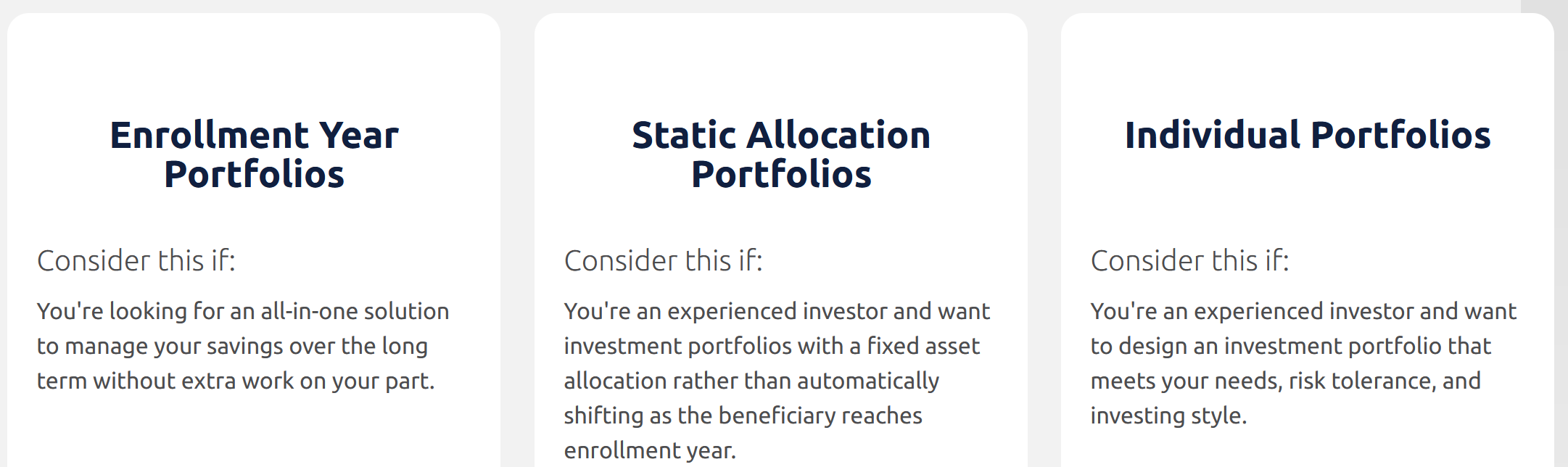
Like many states, the State of Illinois offers three types of plans. A brief description is below.
Enrollment Year Portfolios have you specify the year when the beneficiary will graduate and then they automatically adjust the investments over time. As the graduation year nears, they will shift investments from more risky options (e.g. stocks) into less-risky but lower-performing options (e.g. bonds, money market funds). The expense ratios on these options can be very high!
Static Allocation Portfolios offers a pre-selected basket of mutual funds. Often, they will have themes (e.g. equity, fixed income). Sometimes these can be actively managed, resulting in high fees. For example, the passive equity portfolio has an expense ratio of 0.10%. The active equity portfolio has an expense ratio 2.5x that amount: 0.265%.
Individual Portfolios allow you to invest in a single fund. This is our recommended option for the majority of beneficiaries.
How to pick a plan:
Our recommendation is to select the Individual Portfolio option whenever possible. These options have the lowest fees.
Within the Individual Portfolio options, we follow the advice of the great investor Warren Buffet: “Well, if they’re not going to be an active investor – and very few should try to do that – then they should just stay with index funds. Any low-cost index fund. And they should buy it over time.” In practice, this means that folks should pick a fund that tracks a broad index, such as the S&P 500 or Russell 3000.
Ensure you pick a plan with low fees. We look for fees that are ≤0.10%.
For BrightStart, this would lead folks to pick one of a few Individual Portfolio options: the Vanguard Total Market Index fund (tracks the entire US stock market, 0.08% expense ratio) and the Vanguard S&P 500 Index fund (tracks the S&P 500, 0.08% expense ratio).